
|
Malesian Euphorbiaceae Descriptions |
|
Esser, H.-J. 1999. A partial revision of the Hippomaneae (Euphorbiaceae) in Malesia. Blumea 44: 149–215.
Goto on this page:
Balakata Esser, Blumea 44 (1999) 154; in Radcl.-Sm., Gen. Euphorbiacearum (2001) 378; Esser & Welzen in Chayam. & Welzen, Fl. Thailand 8, 1: 119. 2005; G.L.Webster in Kubitzki, Fam. Gen. Vasc. Pl. 11 (2014) 199. — Sapium sect. Pleurostachya Pax & K.Hoffm. in Engl., Pflanzenr. IV.147.v (1912) 243; in Engl. & Harms, Nat. Pflanzenfam. ed. 2, 19c (1931) 202 (‘Pleurostachys’). — Type: Balakata luzonica (S.Vidal) Esser, based on Myrica luzonica S. Vidal.
Trees. Monoecious. Flowering and fruiting twigs with leaves. Indumentum absent. Stipules triangular, 1.5–2 mm long, entire, glandless. Leaves regularly alternate; petiole short to long (1–9.5 cm long), much shorter to nearly half as long as blade, glandless; blade ovate to oblong to elliptic, 3.5–11 cm wide, base attenuate to acute to slightly cordate, margin entire, apex acuminate to cuspidate, glandless above, below smooth or pale-papillate and with a row of several marginal to submarginal glands, basal ones conspicuously enlarged and usually visible without magnification, rarely absent, secondary veins distinct, arching but not to hardly joined towards the margin, basal ones not differing, intersecondary veins present, tertiary veins percurrent to reticulate, smaller veins reticulate. Inflorescences terminal and axillary, yellowish, once to twice branched, each branch with a distinct sterile basal region, staminate part 20–70 by 2–7 mm; pistillate and staminate flowers in same inflorescence. Bracts of staminate cymules triangular, apically acute, at base with a pair of irregularly pillow-shaped to slightly flattened, sometimes fragmented glands touching the axis of the inflorescence and slightly decurrent. Staminate cymules 5–9-flowered; bracteoles present, membranous, undivided, entire. Staminate flowers with pedicel elongating when flowering, but present also in bud; calyx basally fused with usually 2 irregular, acute tips; stamens 2, filaments slightly longer than anthers. Pistillate flowers (1–)3–13 at base of staminate thyrse or absent; pedicel quite short but distinct (0.5–5 mm long); calyx with 2 sepals, triangular to elliptic, slightly fused at base, entire, glandless; ovary 2-locular, smooth; style short, stigmata 2, undivided, glandless. Fruits with distinct pedicel (1.5–27 mm long); 1–2-seeded, smooth, fleshy berries, indehiscent. Seeds without caruncle, with a thin sarcotesta and a stony seed coat.
Distribution — Two vicariant species, distributed from NE India to Vietnam and China, throughout Malesia, but unknown from Java, the Lesser Sunda Islands, and parts of New Guinea.
Note — The name refers to the official Philippine name for one of the species, balakat gubat. This means ‘shoulder tree’. Thanks are due to C. Ridsdale for providing this translation.
|
1a. |
Leaves ovate to elliptic, below often whitish, petiole (2.5–)3–9.5 cm long. Fruits 2-seeded and sulcate, rarely 1-seeded and globose but then with lateral style. |
|
|
1b. |
Leaves oblong to elliptic, below not whitish, petiole 1–2.2 cm long. Fruits 1-seeded, globose, with apical style. |
Balakata baccata (Roxb.) Esser, Blumea 44 (1999) 155, Map 1; Esser & Welzen in Chayam. & Welzen, Fl. Thailand 8, 1 (2005) 119, plate IV: 4. — Sapium baccatum Roxb. [Hort. Bengal. (1814) 69, nomen] Fl. Ind. ed. 1832, 3 (1832) 694; Wight, Icon. Pl. Ind. Orient. 5, 2 (1853) 6; Baill., Étude Euphorb. (1858) 513; Müll.Arg., Linnaea 32 (1863) 121; Hook.f., Fl. Brit. India 5 (1888) 470; G.Watts, Dict. Econ. Prod. India 6, 2 (1893) 471; Boerl., Handl. Fl. Ned. Ind. 3, 1 (1900) 295; Pax & K.Hoffm. in Engl., Pflanzenr. IV.147.v (1912) 240; Ridl., Fl. Malay Pen. 3 (1924) 315; Gagnep. in Lecomte, Fl. Indo-Chine 5 (1926) 395, 400; Burkill, Dict. Econ. Prod. Malay Pen. 2 (1935) 1960; Corner, Ways. Trees Malaya 1 (1940) 276; K.Heyne, Nutt. Pl. Indon. ed. 3, 1 (1950) 960; Wyatt-Sm., Malay. For. Rec. 23, III-7 (1964): 14; Malay. For. Rec. 17 (1965) 51, 113, 345; Medway, Biol. J. Linn. Soc. 4 (1972) 131, 138, 142; Airy Shaw, Kew Bull. 26 (1972) 329; Whitmore, Tree Fl. Malaya 2 (1973) 128, 129; Airy Shaw, Kew Bull. Add. Ser. 4 (1975) 191; Kew Bull. 36 (1981) 341; Ng, Malay. For. Res. 34 (1991) 83, fig. 65A; Verheij & Coronel (eds.), Pl. Res. SE Asia (PROSEA) 2. Edible fruits and nuts (1991) 382; P.H.Hô, Câyco Viêtnam 2, 1 (1992) 355; I.M.Turner, Gard. Bull. 47 (1995) 231; Y.C. Tseng, Fl. Reipubl. Pop. Sin. 44(3) (1997) 19, pl. 4 fig. 1—3. — Excoecaria baccata (Roxb.) Müll.Arg. in DC., Prodr. 15, 2 (1866) 1211; Kruijt, Biblioth. Bot. 146 (1996) 83. — Carumbium baccatum (Roxb.) Kurz, Forest Fl. Burma 2 (1877) 412. — Type: Roxburgh s.n. (A, P; Icones Roxburghianae 2397), Pakistan, Silhet.
Sapium populifolium Wight, Icon. Pl. Ind. Orient. 5, 2 (1853) tab. 1950, fig. 2. — Excoecaria affinis Griff., Not. Pl. Asiat. 4 (1854) 486, nom. superfl.; Müll.Arg. in DC., Prodr. 15, 2 (1866) 1223; Hook.f., Fl. Brit. India 5 (1888) 470. — Type: Griffith 704 or 706 (GH, K, TCD), Burma, Mergue.
Stillingia paniculata Miq., Fl. Ind. Bat. Suppl. 1 (1861) 183, 461. — Lectotype (designated by Esser, 1999): Teijsmann HB 3677 (holo U; iso K), Sumatra, Palembang, inter Kebus et Labat.
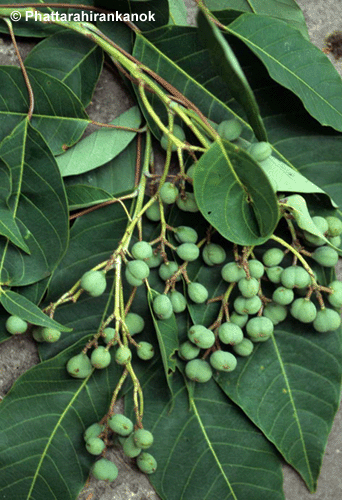
Tree, up to 26 m high, stem up to 60 cm in diam., bole bending and twisting with many knobs, with irregular buttresses up to 4 m high, crown densely leaved. Evergreen. Bark dirty yellow when living, brown to dark grey when dead, with deep longitudinal cracks and fissures; inner bark fibrous. Sapwood cream to white, soft, with a sour to sweet smell. Twigs usually in whorls. Stipules c. 1.5 by 0.5 mm, early caducous and rarely seen. Leaves pinkish brown when young, withering yellow; petiole (2.5–)3.5–9.5 cm long; blade mostly ovate, rarely elliptic, (8–)10–22 by 4–11 cm, base acute to obtuse, rarely attenuate or cordate, not auriculate, margin not revolute, apex acuminate, upper surface hardly shining, lower surface pale-papillate, with (1–)3–12 glands per side, 0.4–0.8(–1.5) mm in diam. and 0–1(–3) mm distant from margin, basal glands 1.5–2.25 mm in diam., usually 4–10 mm above base of blade and sometimes touching midrib, secondary veins 10–16 pairs, angle with midrib initially 75–85°, but soon becoming 45–70°, tertiary veins conspicuous, percurrent. Inflorescences in terminal whorls and in the axils of few uppermost leaves, each branch with an initial covering of numerous elliptic, 2–3 mm long, caducous bracts, later with a sterile basal region 8–12 mm long with no to few bracts, staminate part 20–70 mm by 2–4 mm. Bracts of staminate cymules c. 0.6 mm long, their glands 1–1.75 by 0.5–1 mm, at least superficially disintegrating into numerous nearly circular fragments. Staminate cymules c. 5-flowered. Staminate flowers: pedicel 0.5–1.5 mm long; calyx c. 0.5–1 mm long; stamens with filaments 0.4–0.6 mm long when flowering, anthers 0.25–0.5 mm long. Pistillate flowers 10–13 per thyrse branch or sometimes absent; pedicel 0.6–1 mm long; calyx c. 1 mm long, connate at base; ovary c. 1.5 mm long; style 0.1–0.5 mm long, stigmata 0.75–2 mm long. Fruits: pedicel 1.5–4 mm long; (1–)2-seeded, nearly circular in shape, 8–9 by 9–11 mm, flattened with smallest diameter of 4–5 mm, if 2-seeded sulcate, if 1-seeded with lateral style. Seeds c. 5 by 4.5 mm, blackish.
Distribution — E Himalaya, India (Sikkim) and Bangladesh to Indochina and SW China (only known from Yunnan), Andamans, and in W Malesia: Malay Peninsula (excl. Singapore), Sumatra, Borneo (Kalimantan).
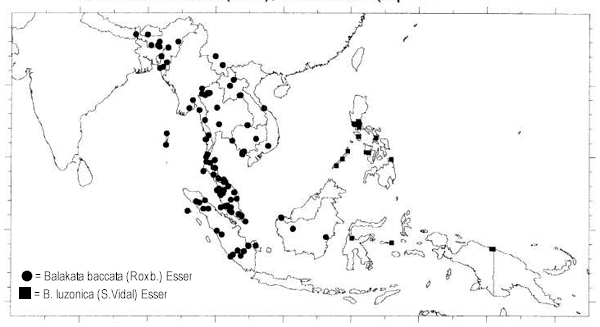 (circles in West Malesia: Southeast Asia, Sumatra, Borneo).
Habitat & Ecology — Found in primary and disturbed Dipterocarp forest, bamboo forest, secondary forest, mixed deciduous forest, also along streams and on hills and slopes; in Selangor (Malaya) it is very common and forms, together with Endospermum malaccense Müll.Arg. (= Endospermum diadenum (Miq.) Airy Shaw), a distinctive forest community of the late succession, poor in Dipterocarps (Wyatt-Smith, 1964). Soil: brown and yellow clay and loam, sandy loam, over limestone, granitic and volcanic bedrock. Altitude 15–1,800 m. Flowers collected in Dec.–Sep.; fruits collected in Jan.–Oct. According to Medway (1972) the trees do not flower annually, and fruit set is rare in the Malayan population studied. The flowers exude a sweet smell (Griffith, 1854).
Uses — Used as a timber tree and as a wayside plant. The wood is not very durable. The fruits are mealy and sweet and in Sumatra sometimes used for a flavouring (Burkill, 1935; Heyne, 1950).
Vernacular names — Sumatra: Bedi, damar kulihap, doelpak dollong, handoelpak, ludai, ludai kantijl. Simaloer Isl.: Banai delok, banai etem.
Note — Two types of inflorescences can be found: purely staminate ones, regularly branched with long branches (each usually 5--7 cm long), and bisexual ones, hardly branched and with shorter branches (each 2--3 cm long); in the last case, the basal pistillate part of the thyrse usually exceeds the staminate part in length.
Balakata luzonica (S.Vidal) Esser, Blumea 44 (1999) 157, Fig. 1, Map 1. — Myrica luzonica S.Vidal, Sin. Gen. Pl. Leños. Filip. Atlas (1883) 40, t. 90 B; Rolfe, J. Linn. Soc., Bot. 21 (1886) 294; Backer, Fl. Males. 4, 3 (1951) 279. — Sapium luzonicum (S.Vidal) Merr., Philipp. J. Sc. 16 (1920) 577; Enum. Philipp. Flow. Pl. 2 (1923) 461; Salvosa, Lex. Philipp. Trees (1963) 123; Airy Shaw, Alph. Enum. Euph. Philipp. Is. (1983) 44. — Lectotype (designated by Esser, 1999): Vidal 610 (K), Philippines, Luzon, San Mateo, Manila; see note.
Sapium lateriflorum Merr., Philipp. J. Sc. 1 Suppl. (1906) 83, nom. illeg., non Hemsley [Hooker's Icon. Pl. (1901) tab. 2680]; Elmer, Leafl. Philipp. Bot. 4 (1911) 1303; Merr., Philipp. J. Sc. 16 (1920) 577. — Sapium merrillianum Pax & K.Hoffm. in Engl., Pflanzenr. IV.147.v (1912) 243, nom. nov.; Kruijt, Biblioth. Bot. 146 (1996) 90. — Lectotype (designated by Merrill, 1920): FB (Borden) 2565 (holo PNH†; iso K, P, US), Philippines, Luzon, Prov. Bataan, Lamao River, Mt. Mariveles.
Urandra elliptica Merr., Philipp. J. Sc., Bot. 5 (1910) 195, non Schellenb. [Bot. Jahrb. 59 (1924) 17, nom. illeg. = Stemonurus ammui (Kaneh.) Sleumer]; Philipp. J. Sc. 16 (1920) 577; Sleumer, Blumea 17 (1969) 263. — Type: FB (Topacio) 20003 (holo PNH†; iso US), Philippines, Luzon, Prov. Bataan.
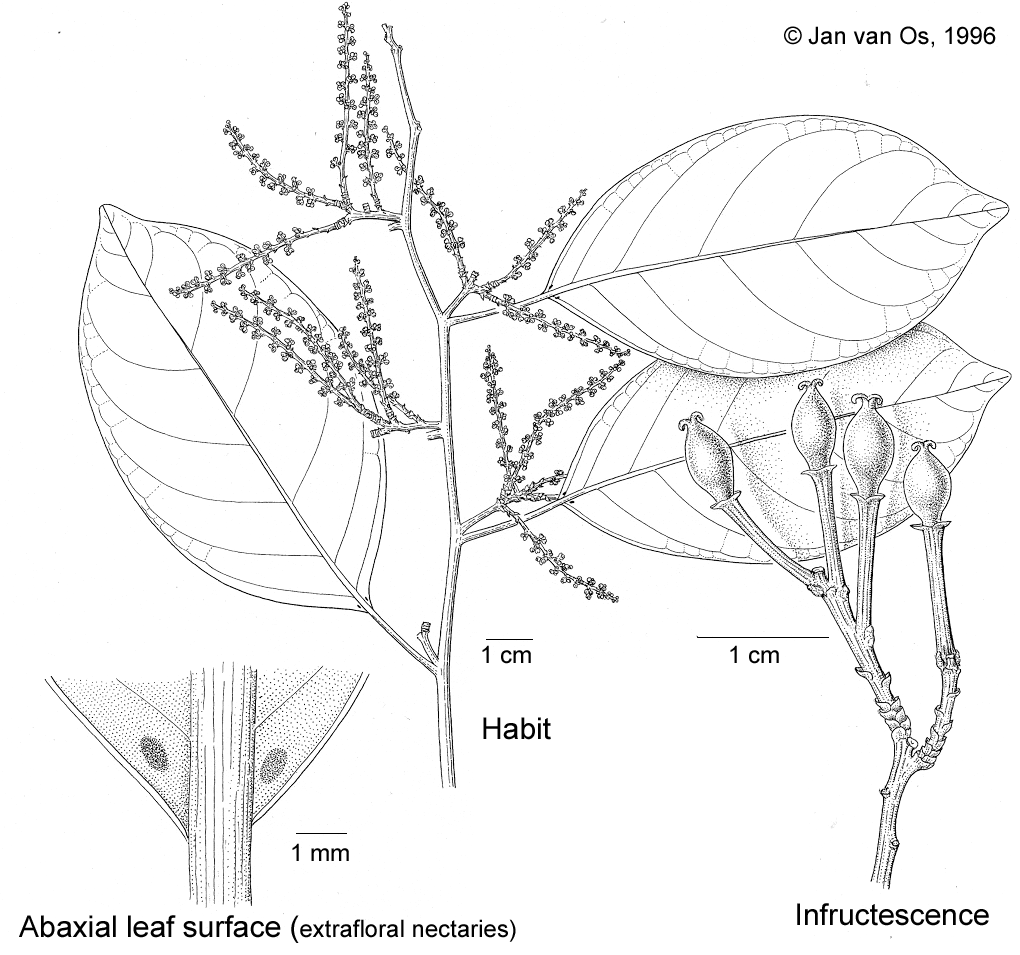
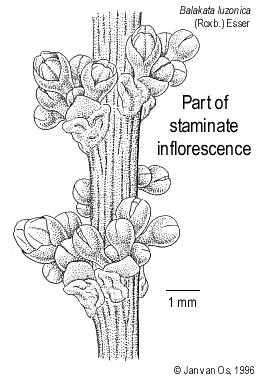
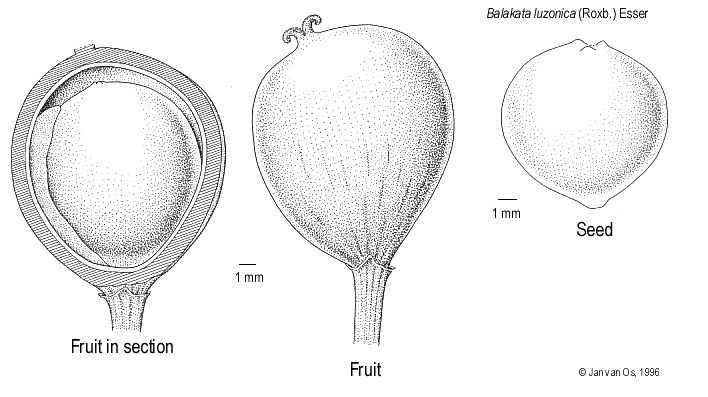
Tree, up to 36 m high, d.b.h. up to 90 cm, bole up to 17 m high. Bark shallowly fissured, strongly peeling with small scales, mid to dark brown; inner bark light brown to white, 10 mm thick. Slash light yellow to red, moderately soft, odour- and tasteless; heartwood dark yellow; cambium white, turning brown. Stipules 1.5–2 by 1.5–2.5 mm. Leaves: petiole 1–2.2 cm long; blade oblong to elliptic, (7–)8–18 by (3.5–)4.5–10.5 cm, base attenuate to obtuse to slightly cordate, often conspicuously auriculate, margin usually revolute, apex acuminate to cuspidate, upper surface shining, lower surface not papillate but smooth and only slightly paler, with 1 or 2(–8) glands per side, 0.2–0.3 mm in diam. and 0.2–0.5 mm distant from margin, basal glands circular to elliptic, 0.5–1.25 by 0.25–0.6 mm, usually 0.5–1 mm above base of blade and not touching midrib, secondary veins 7–9 pairs, angle with midrib 55–65°, tertiary veins inconspicuous and indistinctly percurrent to reticulate. Inflorescences in numerous leaf axils, each branch with basal region 5–10 mm long with tightly packed, distichously arranged, sterile bracts c. 1 mm long, staminate part c. 35–40 by 6–7 mm. Bracts of staminate cymules c. 1.5 mm long, their glands 1.5–2 by 0.6–0.7 mm, not fragmented. Staminate cymules 7–9-flowered. Staminate flowers: pedicel c. 1 mm long; calyx c. 1.25 mm long; stamens with filaments c. 0.75 mm long when flowering, anthers 0.6–0.7 mm long. Pistillate flowers 1–3 per thyrse branch or sometimes absent; pedicel 4–5 mm long; calyx c. 1.25–2 mm long, with nearly free sepals; ovary 3–4 mm long; style c. 0.25 mm long, stigmata c. 1.5 mm long. Fruits: pedicel 8–27 mm long; 1-seeded, nearly circular in shape, 12–17 by 11–15 mm, not flattened and not sulcate, yellowish to green, with fleshy outer layer c. 0.4 mm thick, woody part of pericarp 0.15–0.25 mm thick, style apical.
Distribution — Endemic to Malesia: Philippines (Luzon, Mindoro, Palawan, Ticao, Bucas Grande, Mindanao), Moluccas (Mangoli), New Guinea.
(squares in East Malesia: Philippines, Sulawesi, New Guinea).
Habitat & Ecology — Found in the canopy of primary or secondary, dry semi-deciduous forests, also on steep hillsides and slopes and on the foot of a limestone hill bordering mangrove swamp. Locally very common and dominant. Soil: clay, sand, volcanic rock. Altitude 10–120 m. Flowers collected in Oct.–Dec., Mar.; fruits collected in Feb.–June, Sep.
Uses —The wood is of potentially commercial value [Lomibao, Philipp. Lumberman 19 (1973) 22–29].
Vernacular names — Philippines: Balákat-gúbat [official common name fide Phil. J. For. 5 (1974) 75, 135], mogalmod (Tagbanua); several additonal ones are listed by Merr., Enum. Philipp. Flow. Pl. 2 (9123) 461. New Guinea: Seganamuung, sogonam, sogonamung (Kemtoek).
Note — The original type citation is "Montalvan? (Manila)". No specimen with this locality information could be traced. However, the collection Vidal 610, from San Mateo, Manila, seen and annotated by Rolfe, can be considered as authentic material, and is therefore proposed as a lectotype.
