
|
Malesian Euphorbiaceae Descriptions |
|
Welzen, P.C. van, R.A. Banka & C.D. Leoncito. 1993. A Revision of the Malesian monotypic genus Cheilosa Blume (Euphorbiaceae). Blumea 38: 161–166.
Goto on this page:
Cheilosa Blume, Bijdr. (1825) 613; Pax in Engl. & Prantl, Nat. Pflanzenfam. 3, 5 (1890) 90; Pax & K.Hoffm. in Engl., Pflanzenr. IV, 147, 4 (1912) 12; 14 (1919) 50; Back. & Bakh. f., Fl. Java 1 (1963) 496; Whitmore, Tree Fl. Malaya 2 (1973) 77; Airy Shaw, Kew Bull. Add. Ser. 4 (1975) 68; Kew Bull. 36 (1981) 276; Welzen, Banka & Leoncito, Blumea 38 (1993) 162; Radcl.-Sm., Gen. Euphorbiacearum (2001) 120; G.L.Webster in Kubitzki, Fam. Gen. Vasc. Pl. 11 (2014) 105. — Type: Cheilosa montana Blume
Tree, dioecious, base fluted; branchlets with relatively wide pith. Stipules early caducous. Leaves alternate, simple; petiole basally and apically pulvinate; pulvinus often with transverse grooves; blade symmetric, not punctate, without exudate; base cuneate to emarginate; margin dentate to crenate, with abaxially gland in every tooth; apex rounded to obtuse (to acuminate); lower surface with simple and often with fascicled hairs, glabrescent; venation pinnate, looped at the margin with a vein from every loop to the gland. Inflorescences ramiflorous to axillary to terminal, thyrsoid with 1 to several branches per axil; branches flat, usually unbranched; cymules mono- to dichasial, with 1–3 flowers; bracts to the cymules often leaf-like; bracts to the flowers often with two basal extensions as if bracts and bracteoles are united. Flowers actinomorphic; pedicels elongating in fruit; sepals 5 (or 6), free, ovate, imbricate, thin to coriaceous, margin often membranous, sericeous, glabrescent, long resistent in fruit; petals absent; disc annular, flat, more or less 5-lobed, hirsute, resistent in fruit. Staminate flowers with 9 or 10 stamens in 2 whorls; filament flattened, glabrous; anther basifixed, opening latrorsly lengthwise, glabrous; connective often slightly elongated; pistillode with (2 or) 3( or 4) free, hirsute remnants of the carpels. Pistillate flowers without stamens; ovary 3- (to seldom 4)-locular; 1 ovule per locule, descending, epitropous, anatropous, subapically attached to column; style short; stigmas 3, spreading outwards, upper surface papillate, apically split apart and recurved. Fruits rhegmas, ovoid (to globular), slightly triangular in transverse section, outside smooth, tomentose, inside smooth, glabrous; column left after dehiscence; mesocarp woody, cork-like in appearance; septa complete. Seeds 1–3 per fruit, ovoid with a convex abaxial surface and a V-shaped, almost flat adaxial surface, both surfaces with longitudinal keel in the center; aril surrounding seed completely, adnate to seed; endosperm present, with a central longitudinal, flat embryo.
Distribution — As the species.
Cheilosa montana Blume, Bijdr. (1825) 614; Pax & K.Hoffm. in Engl., Pflanzenr. IV, 147, 4 (1912) 12, fig. 3; S.Moore, J. Bot. Brit. For. 63 (1925) 104; Back. & Bakh. f., Fl. Java 1 (1963) 496; Airy Shaw, Kew Bull. Add. Ser. 4 (1975) 68 (sub Ch. malayana); Welzen, Banka & Leoncito, Blumea 38 (1993) 163, Fig. 1, 2. — Type: Blume s.n. (L, holo, sheet no. L.903.155-415; iso in BM, F, L, NSW, P, US, Z), Indonesia, Java.
Baliospermum malayanum Hook.f., Fl. Brit. India 5 (1888) 463; Ridl., Fl. Malay Pen. 3 (1924) 313. — Scortechinia malayana Ridl., Fl. Malay Pen. 5 (1925) 332, in note. — Cheilosa malayana Corner ex Airy Shaw, Kew Bull. 16 (1963) 364; Kew Bull. 20 (1966) 49; Whitmore, Tree Fl. Malaya 2 (1973) 77; Airy Shaw, Kew Bull. Add. Ser. 4 (1975) 68; Kew Bull. 36 (1981) 276. — Type: Maingay KD 1455 (K, holo), Peninsular Malaysia.
Cheilosa homaliifolia Merr., Philip. J. Sci., Bot. 8 (1913) 379; Pax & K.Hoffm. in Engl., Pflanzenr. IV, 147, 14 (1919) 50; Merr., En. Philip. 2 (1923) 457. — Type: Wenzel 147 (PNH, †; iso in A, F, G, MO, NSW, US), Philippines, Leyte, Dagami.
Cheilosa spec.: Merr., J. Str. Br. Roy. As. Soc., spec. issue (1921) 346. (pro Villamil 31, n.v., Borneo, Sabah = British North Borneo).
Cheilosa homaliifolia Merr. var. grandifolia Merr., En. Philip. 2 (1923) 457. — Type: BS (Ramos & Edaño) 37282 (PNH, holo, †; iso in K), Philippines, Mindanao, Zamboanga Distr., Malangas.
Cheilosa montana Blume var. longifolia S.Moore, J. Bot. Brit. For. 63 (1925) 104. — Type: Forbes 1839 (BM, holo; iso in L), Indonesia, Sumatra, Lampongs, Mt. Tengemoes.
Baccaurea malayana auct. non King ex Hook.f.: Hook.f., Fl. Brit. India 5 (1887) 374, excl. Hedycarpus malayanus Jack; Boerl., Handl. Fl. Ned. Indië 3, 1 (1900) 280, in note; Pax & K.Hoffm. in Engl., Pflanzenr. IV, 147, 15 (1922) 70; Ridl., Fl. Mal. Pen. 3 (1924) 247; Burkill, Dict. Econ. Prod. Malay Pen. 1 (1935) 279; Corner, Gard. Bull. Str. Settl. 10 (1940) 290 (conclusion). See note in Airy Shaw (1963: 364).
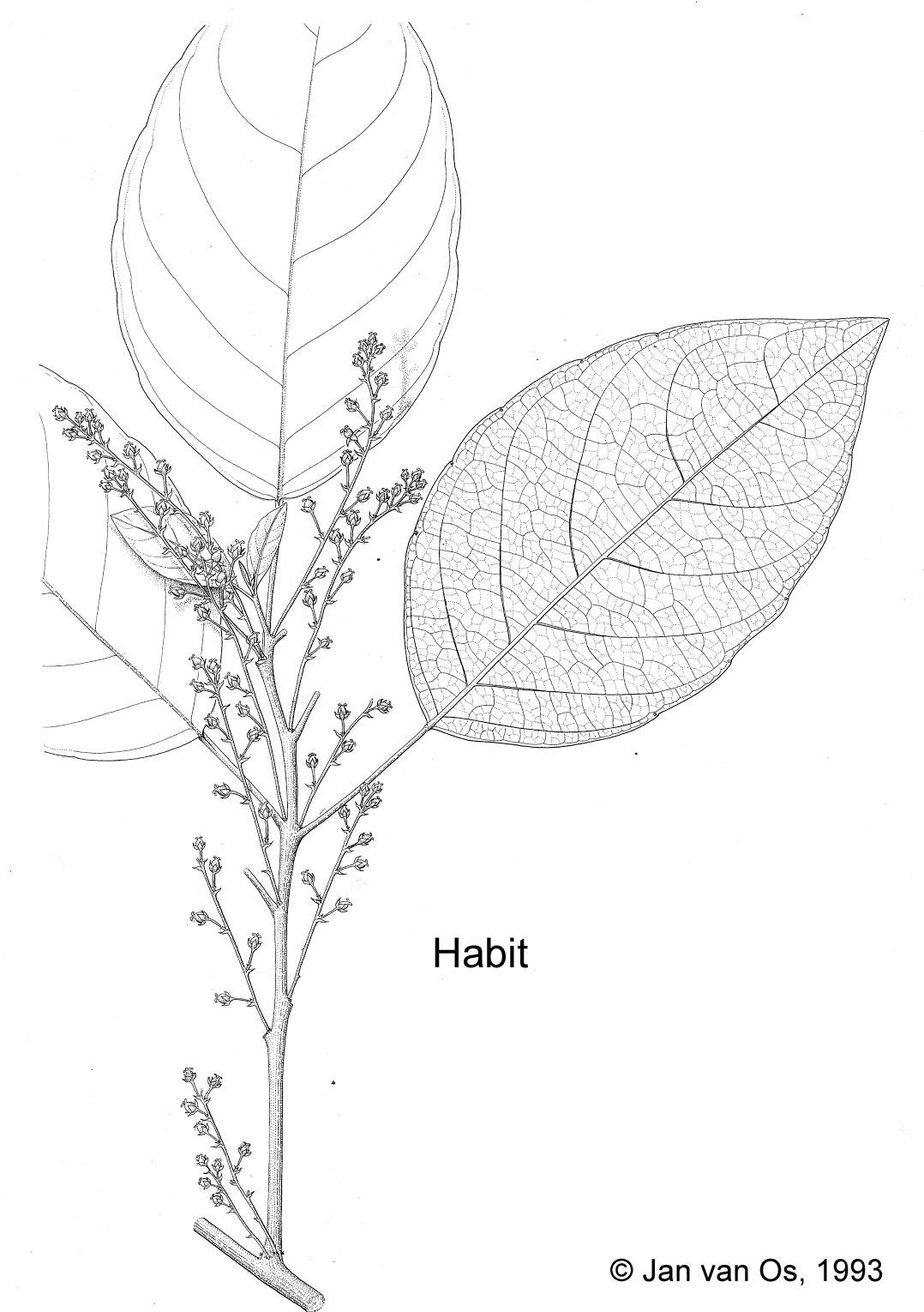
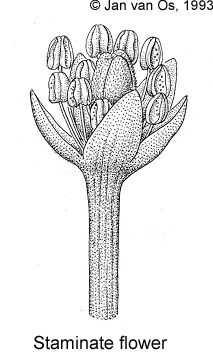
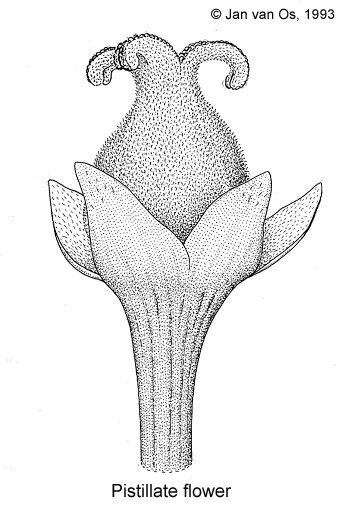
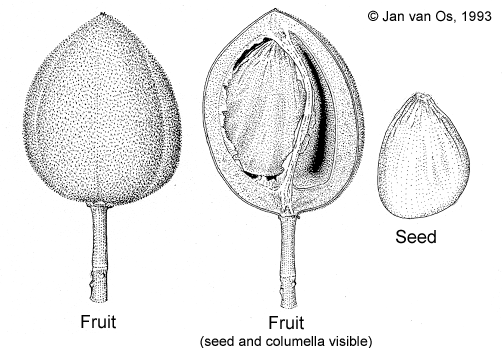
Tree, up to 28 m high by 50 cm d.b.h. Outer bark grey-brown to brown, rather smooth; inner bark orange-brown; slash smelling like fresh sugar-cane; exudate white; wood white (to yellow). Branchlets rounded, smooth to somewhat rough, glabrescent; flowering twigs 2–11 mm thick. Stipules triangular, 1–1.7 by 0.6–0.8 mm, sericeous. Leaves: petiole 0.7–8.5 cm long, round to dorsoventrally flattened; blade ovate to obovate, 5.6–32.5 by 2.8–16 cm; base narrowly cuneate to emarginate; margin shallowly (to deeply) laxly dentate to crenate, flat; apex rounded to obtuse (to acuminate), very apex rounded (to mucronulate); upper surface smooth, glabrous; lower surface smooth, simple hairs somewhat sericeous (to hirsute: see note), glabrescent, fascicled hairs usually present especially near midrib; venation with 6–9 pairs of opposite to alternate nerves, tertiary veins partly scalariform, other veins widely reticulate. Inflorescences: branches 0.5–17 cm long, sericeous; bracts to cymules elliptic to obovate, 1.4–6 by 0.7–1.8 mm, coriaceous, apex rounded to acute, sericeous on both sides; bracts to the flowers triangular, 0.7–1.5 by 0.4–2 mm, subglabrous to sericeous. Peduncles 0.7–2.3 mm long, in fruit up to 8 mm long, short sericeous to glabrescent. Staminate flowers 2.2–3.5 mm in diam, greenish; sepals 1–1.5 by 0.6–1.3 mm; filaments 0.5–2.8 mm long; anthers 0.4–0.8 by 0.3–0.7 mm. Pistillate flowers c. 5 mm in diam.; sepals 1.5–3.2 by 1.2–2 mm; ovary ovoid, 2–4 mm high, hirsute; style c. 0.5 mm long, hirsute; stigmas 3, 1.1–1.7 mm long, upper surface glabrous, split part 0.5–1.2 mm long. Fruits 1 to 5 per inflorescence branch, 2.2–5.2 by 2–4.3 cm, velvety greenish grey; wall 1.5–6 mm thick. Seed 1.5–3.3 by 1.4–2.2 by 0.8–1.3 cm, black; aril up to 1.5 mm thick, outside orange, inside yellow, oily; embryo 9.5–19 by 8–15 mm, white; plumule and radicle 2–4 mm long.
Distribution — Malesia: Malay Peninsula (incl. Singapore), Sumatra, W Java, Borneo, S Philippines.
Habitat & Ecology — Primary and hill forest, swamp forest, along rivers, on ridges. Soil: yellow clay to red sand. Alt.: 5–1200 m. Flowering: February, June to November; fruiting: April to October. Some branches hollow due to insects.
Vernacular names — Malay Peninsula, Selangor: nawe, jahakah. Sumatra, Palembang area: betih rawang. Borneo, around Balikpapan: kepajang hutan, ketapi danau.
Note — Burley, Tukirin et al. 2478 (Borneo) and BS 37282 (Philippines) show subhirsute leaves. All other specimens are subglabrous or slightly sericeous.
Cheilosa whiteana Croizat, J. Arn. Arbor. 23 (1942) 507; Airy Shaw, Kew Bull. 16 (1963) 365, in note. — Type: FB (Curran) 17733 (A, holo), Philippines, Luzon, Prov. of Pampanga, Mt. Arayat. = Trigonostemon whiteanus (Croizat) Airy Shaw, Kew Bull. 38 (1983) 68.
Note: The species is only known from the type specimen. The latter only possesses a few withered pistillate flowers. The species differs from Cheilosa by having two basal glands on the upper surface of the leaf-blade (absent in Cheilosa), the presence of petals (absent in Cheilosa), and hardly split stigmas (deeply split in Cheilosa). The leaves also show a rather strongly trinerved leaf-base. The transfer to Trigonostemon is still doubtful as strongly ovate, crenate leaves are rare in this genus.
