
|
Malesian Euphorbiaceae Descriptions |
|
Welzen, P.C. van. 1999. Revision and Phylogeny of subtribes Chrozophorinae and Doryxylinae (Euphorbiaceae). Blumea 44: 411–36.
Goto on this page:
Chrozophora Neck. ex A.Juss., Euphorb. Gen. (1824) 27 (‘Crozophora’), nom. & orth. cons.; Müll.Arg. in DC., Prodr. 15, 2 (1866) 746; Pax & K.Hoffm. in Engl., Pflanzenr. IV.147.vi (1912) 17; Prain, Bull. Misc. Inform. (1918) 49; Airy Shaw, Kew Bull. 26 (1972) 232; G.L.Webster, Ann. Missouri Bot. Gard. 81 (1994) 73; Welzen, Blumea 44 (1999) 419; Radcl.-Sm., Gen. Euphorbiacearum (2001) 151; Welzen in Chayam. & Welzen, Fl. Thailand 8, 1 (2005) 156; G.L.Webster in Kubitzki, Fam. Gen. Vasc. Pl. 11 (2014) 142, Fig. 32. — Type: Croton tinctorium L. [= Chrozophora tinctoria (L.) A. Juss.]
Herb or undershrub, monoecious. Indumentum consisting of very dense, sessile and peduncled stellate or lepidote hairs, next to simple hairs (latter mainly on lower leaf surface). Stipules narrowly triangular, tomentose, caducous, scars very indistinct. Leaves spirally arranged, simple; petiole not pulvinate, reniform in transverse section; blade ovate, often 3-lobed, coriaceous, symmetric, margin shallowly to laxly but distinctly crenate, apex rounded, upper surface less densely covered by hairs than lower surface, the latter usually basally with 2 glands near insertion and often with submarginal glands, glands crater-like (circular, rim-like wall, concave inside); venation basally trinerved, pinnate along midrib with nerves ending open in the margin, veins laxly scalariform, quaternary veins reticulate. Inflorescences terminal racemes (in fruit pseudo-lateral and opposite to leaf due to extension of axillary buds), solitary (or 2 together), not branching, basal flowers pistillate, apical ones staminate; rachis tomentose. Bracts narrowly triangular, only hairy outside. Flowers actinomorphic, staminate flowers usually 2 per node, pistillate flowers usually single; pedicels with abscission zone; calyx 5-lobed, valvate, tomentose outside, glabrous inside; petals 5; disc indistinct, glabrous. Staminate flowers subsessile; calyx campanulate, lobes ovate; petals slightly larger than sepals, obovate, petaloid, margin in upper part undulate, with simple hairs on both sides; disc divided into small glands, united with petals; stamens 13–16, glabrous, filaments united into a column, branching off in c. 3 layers, free part thread-like, anthers basidorsi-fixed, 4-locular, opening extrorse with lengthwise slits; pistillode absent. Pistillate flowers pedicellate; calyx and petals persistent, both 5-merous, narrowly ovate, hairy outside, glabrous inside, petals sepaloid in texture, slightly smaller than calyx; disc annular, very flat; pistil 3-locular, on short gynophore, one ovule per locule, smooth, covered by flat stellate hairs; style short, hairy, persistent; stigmas almost completely divided, below stellately hairy, above with long slender papillae, persistent. Fruits slightly lobed capsules, triangular in transverse section, dehiscing usually septicidally and partly loculicidally into 3 bivalved parts, outside densely stellate, inside glabrous, thin-walled; column slender, with frayed remnants of the septa, apically triangular; septa single veined?. Seeds 3 per fruit, obovate, angular; covered by a thin, incomplete sarcotesta; the latter carunculate apically. Embryo flat; endosperm copious.
Distribution — Eleven species from Africa and the Mediterranean through SW and S Asia to SW Asia. In Malesia a single species, probably accidentally introduced into Central Java.
Chrozophora rottleri (Geiseler) A.Juss. ex Spreng., Syst. Veg. 3 (1826) 850; Pax & K.Hoffm. in Engl., Pflanzenr. IV.147.vi (1912) 19; Prain, Bull. Misc. Inform. (1918) 95 (see there for full synonymy); Steenis, Bull. Jard. Bot. Buitenzorg ser. 3, 17 (1948) 399; Nath, Bot. Surv. S. Shan States (1960) 109; Backer & Bakh.f., Fl. Java 1 (1964) 477; Welzen, Blumea 44 (1999) 420, Fig. 2, Map1; in Chayam. & Welzen, Fl. Thailand 8, 1 (2005) 156, fig. 34. — Croton rottleri Geiseler, Croton Monogr. (1807) 54; A. Juss., Euphorb. Tent. (1824) 28. — Chrozophora plicata (Vahl) A.Juss. ex Spreng. var. rottleri (Geiseler) Müll.Arg. in DC., Prodr. 15, 2 (1866) 747. — Type: Vahl s.n., s.d. (C, n.v.; IDC microfiche 2201-1).
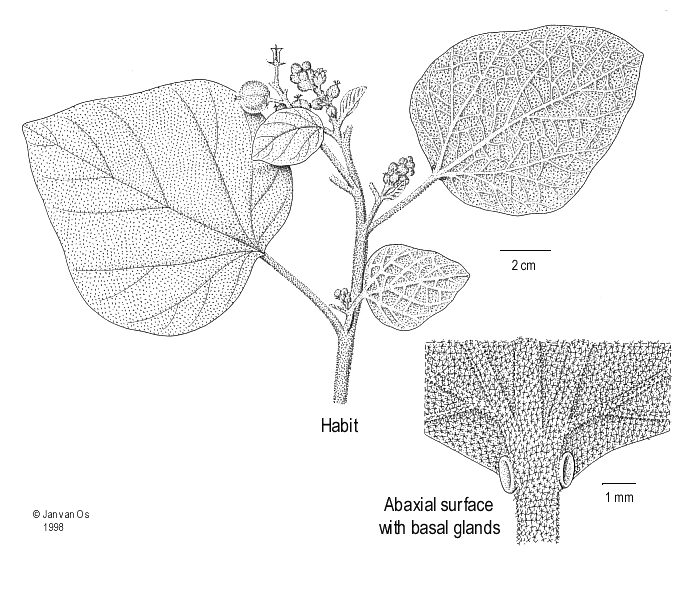


Herb to undershrub, up to 60 cm high; flowering twigs 2–2.5 mm thick. Indumentum consisting of stellate and (few) simple hairs. Stipules 1.3-2.7 by c. 0.3 mm. Leaves: petiole 0.8–5.5 cm long; blade ovate, not to usually distinctly 3-lobed, 2.6–9 by 2.6–9 cm, index 1–1.9, pale green, base obtuse to usually emarginate, margin without distinct glands, lower surface with 2 glands near the base, 1 mm in diam., and usually several smaller ones submarginally, venation impressed above, raised below, nerves c. 4 per side. Inflorescences up to 4 cm long, elongating in fruit to up to 10 cm long. Bracts very inconspicuous to c. 1.6 by 0.3 mm. Staminate flowers 4–6 mm in diam., yellow; calyx white, united part c. 1 mm high, lobes 3.2–4 by c. 1.2 mm; petals 3.7–3.8 by 1.5–1.6 mm; androphore 3.3–3.8 mm long, basal 1.2–1.3 mm without filaments; filaments 0.3–0.8 mm long; anthers 0.9–1.3 by c. 0.7 mm, yellow. Pistillate flowers 3.2–3.3 mm in diam., (greenish to) yellow; pedicel 1.4–2 mm long, elongating in fruit to up to 1.1 cm; calyx lobes only basally united, 1.5–2.2 by 0.5–0.7 mm; petals 1.3–2 by 0.4–0.6 mm; ovary ovoid, 2.7–3 by 2.2–3 mm wide; style 0.5–0.8 mm long, red, stigmas erect, up to 2.3 mm long, apically split for up to 1.8 mm, red. Fruits 8–9 by c. 5 mm; column after dehiscence 3–3.5 mm long. Seeds 3.8–3.9 by 3.2–3.6 by 3–3.2 mm.
Distribution — India, Myanmar, Thailand, Andaman Islands, and Malesia: Central Java. The plant has probably been introduced accidentally into Java, because it is only known from an area of a sugar cane factory.

Habitat & Ecology — Locally common in wet places like waste areas, along roads, and along and in stream beds. Soil: clay (mud), sand. Alt.: 10–200 m. Flowering and fruiting: December-September, but perhaps the whole year through.
Uses — The fruits provide a blue-colouring dye, though the plant has never been cultivated for this purpose.
Note — Chrozophora plicata (Vahl) A.Juss. ex Spreng. is often confused with C. rottleri, because one of the first leads in Prain’s key (1918) asks for the length of the inflorescence relative to the surrounding leaves. The inflorescence should be shorter than the leaves in C. plicata and longer in C. rottleri. However, they are only longer in C. rottleri when the inflorescences are old and have shed their seeds. The best character to separate both species is in the stellate hairs on the ovary/fruit, these hairs are flat, 2-dimensional, almost lepidote in C. rottleri (lacking the patent hairs), and normal, 3-dimensional in C. plicata. Furthermore, the leaf blades in C. plicata are usually smaller (less than 3 cm long) and of a much darker green (at least when dry).
