
|
Malesian Euphorbiaceae Descriptions |
|
Esser, H.-J. 1999. A partial revision of the Hippomaneae (Euphorbiaceae) in Malesia. Blumea 44: 149–215.
Goto on this page:
Shirakiopsis Esser, Blumea 44 (1999) 184; in Radcl.-Sm., Gen. Euphorbiacearum (2001) 380; Kew Bull. 56 (2001) 1017; Esser & Welzen in Welzen & Chayam., Fl. Thailand 8, 2 (2007) 554; G.L.Webster in Kubitzki, Fam. Gen. Vasc. Pl. 11 (2014) 195 (sub Gymnanthes). — Shirakia Hurus., J. Fac. Sci. Univ. Tokyo, Sect. 3, Bot. 6 (1954) 317, pro parte excl. type; Kruijt, Biblioth. Bot. 146 (1996) 7, 91, pro parte excl. type. — Excoecaria sect. Parasapium Müll.Arg., Linnaea 32 (1863) 123. — Excoecaria sect. Sclerocroton (Hochst.) Müll.Arg. subsect. Parasapium (Müll.Arg.) Müll.Arg. in DC., Prodr. 15, 2 (1866) 1216. — Sapium sect. Parasapium (Müll.Arg.) Hook.f., Fl. Brit. India 5 (1888) 471; Pax & K.Hoffm. in Engl., Pflanzenr. IV.147.v (1912) 249; in Engl. & Harms, Nat. Pflanzenfam. ed. 2, 19c (1931) 202. — Type: Sapium indicum Willd. [= Shirakiopsis indica (Willd.) Esser]
Trees. Monoecious. Flowering and fruiting twigs with leaves. Indumentum consisting of pale to yellowish (reddish in some African taxa), multicellular, uniseriate hairs. Stipules ovate to triangular, 1–2 mm long, undivided, glandless. Leaves regularly alternate; petiole 0.6–2 cm long, much shorter than blade, glandless; blade oblong to elliptic to ovate, base obtuse to slightly attenuate, margin serrate with teeth 3–5 mm apart, apex acute to acuminate, glandless above, lower surface paler than upper one but not whitish and not papillate, with 0–10 strictly marginal glands on each side, basal ones slightly larger but very similar, secondary veins quite numerous (15–26 pairs) and arching but not joined towards the margin, basal pair similar. Inflorescences terminal, yellowish, simple, without sterile basal region, pistillate and staminate flowers in same thryse, each thyrse 40–120 by 4–6 mm, pilose. Bracts of staminate cymules triangular, pilose to ciliate, at base with a pair of elongate-spheroidal to elliptical glands touching the axis of the thyrse and sometimes decurrent. Staminate cymules (3–)5–7-flowered. Staminate flowers with distinct (1–3 mm long) pedicel in bud and when flowering; calyx with 3 sepals, fused at base; stamens 3, filament and anther of similar length. Pistillate flowers 1–3 at base of staminate thyrse, sometimes absent; pedicel distinct; calyx with 3 (2 in African species) sepals, irregularly triangular, fused at base, glandless; ovary 3-locular (2-locular in African species), smooth, usually glabrous; style present, stigmata 3 (2 in African species), undivided, glandless. Fruits distinctly (at least 8 mm) pedicellate; 3-seeded (2-seeded in African species) mericarps, smooth, dry and woody (partly fleshy in S. virgata), regularly dehiscent along the septa (sometimes tardily so); mericarps with very thick pericarp in Malesian taxa (fruit length/pericarp thickness > 10:1; but much thinner in African taxa), septa with a separate basal triangle and 1 vascular strand, central columella alate. Seeds elliptic, dry, caruncle very inconspicuous to absent.
Distribution — Six species, from these three in tropical Africa and three in tropical Asia from India to Cambodia and throughout Malesia up to the Caroline and the Solomon Islands in the Pacific.
Note — Except for the unusually thick pericarp of the fruits and the indumentum, the genus is characterized mostly by the absence of characters. Its circumscription is still insufficient, but an elaboration would require comparative studies of African and Neotropical taxa, too. The species are very similar to each other, but at least the fruits allow clear distinctions.
|
1a. |
Fruits acute at both ends, longer than wide, always with a fleshy outer layer — Java |
|
|
1b. |
Fruits basally rounded to slightly attenuate, at least as wide as long, dry when ripe — Outside Java |
|
|
2a. |
Fruits very hard, hardly and slowly but regularly opening, hardly sulcate — widespread in Malesia, but absent from the Philippines and the Lesser Sunda Islands |
|
|
2b. |
Fruits regularly and easily opening, deeply sulcate — Philippines, Lesser Sunda Islands |
Shirakiopsis indica (Willd.) Esser, Blumea 44 (1999) 185, Map 5; Esser & Welzen in Welzen & Chayam., Fl. Thailand 8, 2 (2007) 555, Fig. 82, Plate XXIX: 3. — Sapium indicum Willd., Sp. Pl. ed. 4, 4 (1805) 572; Roxb., Hort. Bengal. (1814) 69; Fl. Ind. ed. 1832, 3 (1832) 692; Buch.-Ham., Trans. Linn. Soc. 17 (1837) 229; Hassk., Retzia 1 (1855) 158; Wight, Icon. Pl. Ind. Orient. 6 (1853) tab. 1950; Baill., Étude Euphorb. (1858) 513; Benth., J. Linn. Soc., Bot. 17 (1878) 242; in Benth. & Hook.f., Gen. Pl. 3 (1880) 335; Hook.f., Fl. Brit. India 5 (1888) 471; G.Watts, Dict. Econ. Prod. India 6, 2 (1893) 471; Pax & K.Hoffm. in Engl., Pflanzenr. IV.147.v (1912) 251; Merr., Interpr. Rumph. Herb. Amboin. (1917) 328; J.J.Sm. in Herderschee, Nova Guinea 12 (1917) 548; Merr., Bibl. Enum. Bornean Pl. (1921) 348; Ridl., Fl. Malay Pen. 3 (1924) 317; Gagnep. in Lecomte, Fl. Indo-Chine 5 (1926) 394; Burkill, Dict. Econ. Prod. Malay Pen. 2 (1935) 1961; Corner, Ways. Trees Malaya 1 (1940) 277; K.Heyne, Nutt. Pl. Indon. ed. 3, 1 (1950) 961; Airy Shaw, Kew Bull. 26 (1972) 330; Whitmore, Tree Fl. Malaya 2 (1973) 128, 129; Ng, Malay. For. Res. 34 (1991) 83, fig. 65B; I.M.Turner, Gard. Bull. 47 (1995) 231. — Excoecaria indica (Willd.) Müll.Arg., Linnaea 32 (1863) 123; in DC., Prodr. 15, 2 (1866) 1216; Kurz, Forest Fl. Burma (1877) 413; J.J.Sm. in Koord. & Valeton, Bijdr. Boomsoort. Java 12 (1910) 615; Airy Shaw, Kew Bull. Add. Ser. 4 (1975) 114; Kew Bull. Add. Ser. 8 (1980) 89; Kew Bull. 36 (1981) 297; Kew Bull. 37 (1982) 20; Goel & Chakrab., J. Econ. Tax. Bot. 14 (1990) 738; Verheij & Coronel (eds.), Pl. Res. SE Asia (PROSEA handb.) 2, Edible fruits and nuts (1991) 376; Purwaningsih in Lemmens & Wulijarni-Soetjipto (eds.), Pl. Res. SE Asia (PROSEA handb.) 3, Dye and tannin-producing plants (1991) 73, 74; P.H. Hô, Câyco Viêtnam 2, 1 (1992) 353. — Shirakia indica (Willd.) Hurus., J. Fac. Sci. Univ. Tokyo, Sect. 3, Bot. 6 (1954) 317; Kruijt, Biblioth. Bot. 146 (1996) 93. — Type: Herb. Willdenow fol. 17946 = Buchanan Hamilton s.n. (holo B-WILLD, n.v., IDC microfiche 1297/7), India, Tripura; see note 1.
Sapium bingiricum Roxb. ex Baill., Étude Euphorb. (1858) 513, Atlas (1858) pl. 6, fig. 10–11. — Type: Herb. Roxburgh s.n. (holo G; ?iso BM, BR; Icones Roxburghianae 1296); see note 1.
Stillingia diversifolia Miq., Fl. Ind. Bat. Suppl. 1 (1861) 461. — Excoecaria diversifolia (Miq.) Müll.Arg. in DC., Prodr. 15, 2 (1866) 1211; Kruijt, Biblioth. Bot. 146 (1996) 88. — Sapium diversifolium (Miq.) Boerl., Handl. Fl. Ned. Ind. 3, 1 (1900) 296. — Type: Teijsmann HB 4215 (holo U; drawing of U sheet in A; iso G-DC, n.v., IDC microfiche 2619/9), Sumatra, Lampong, a fluv. Toelang bawang.
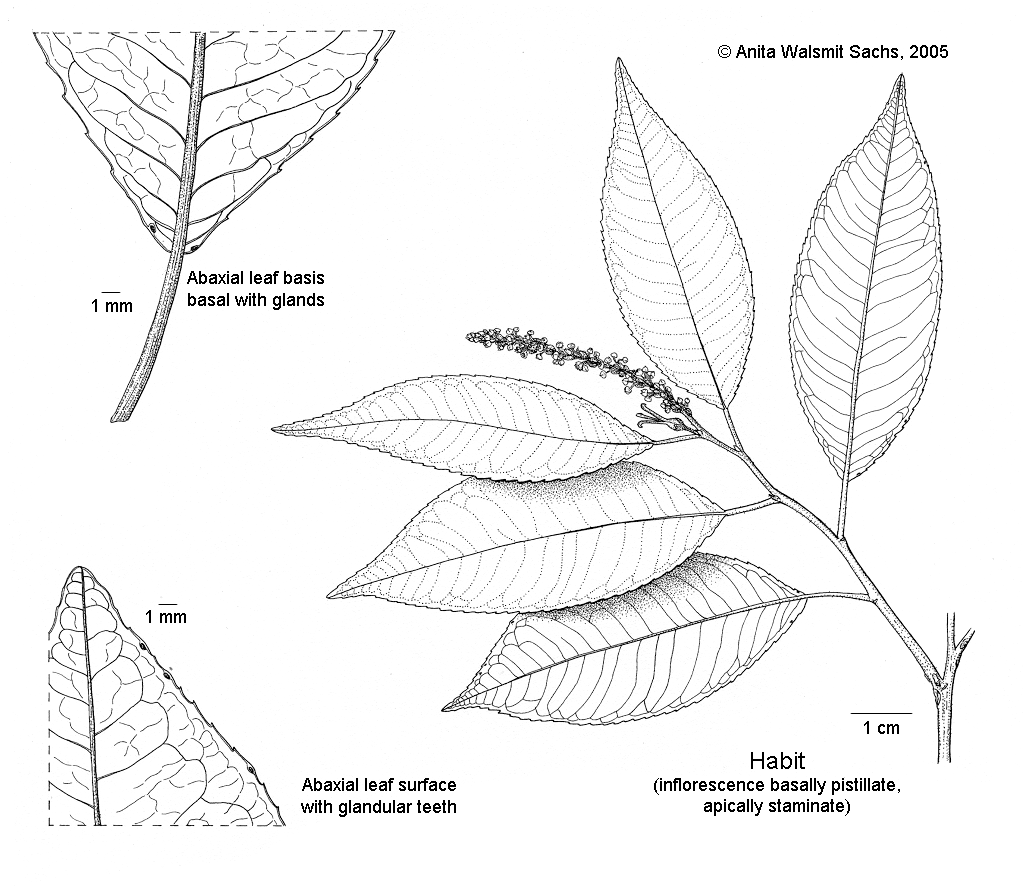
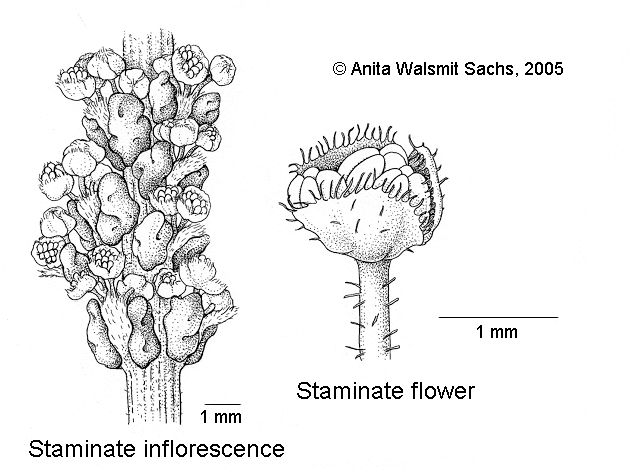
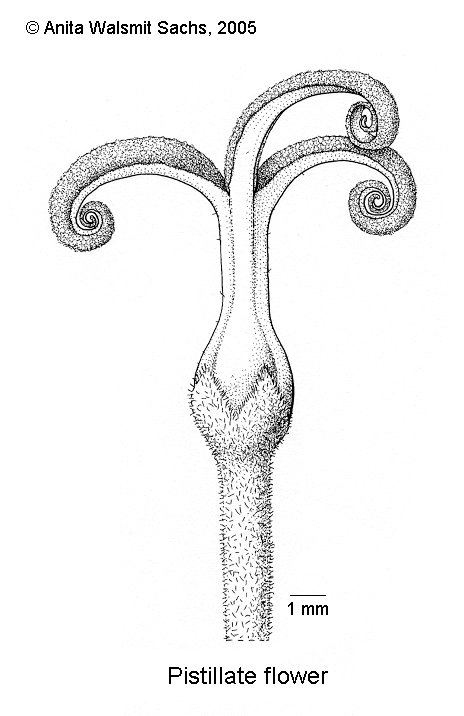
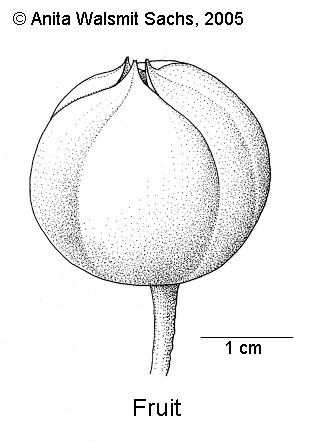
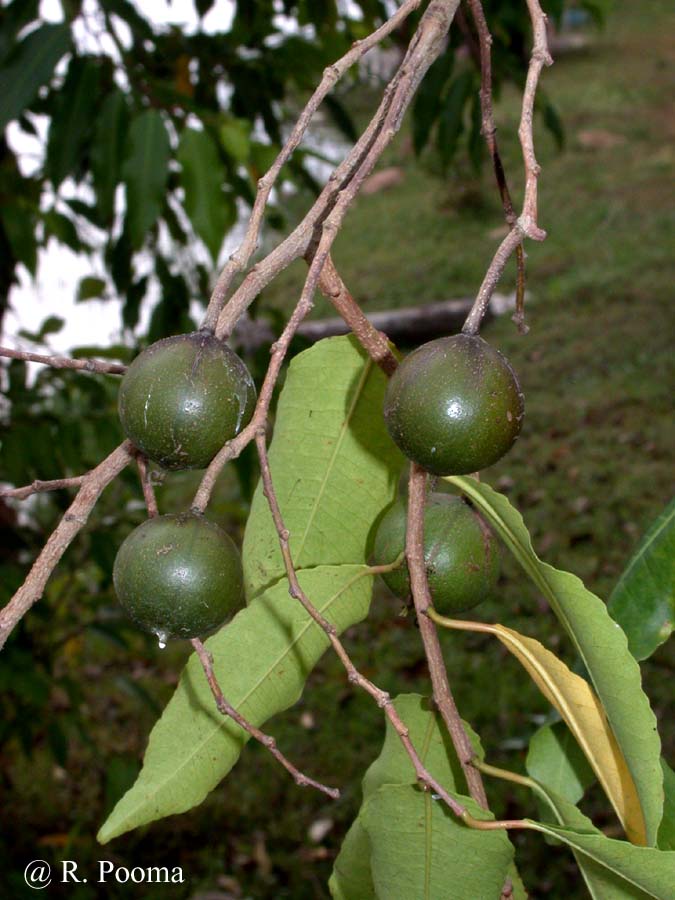
Tree, up to 30 m high, stem diameter up to 40 cm, bole twisting, with spines at base and buttresses up to 2 m high, branching from base. Young twigs pilose, especially in axils. Indumentum pale to yellowish. Bark brown greyish to olive, 2–4 mm thick, vertically furrowed and fissured, peeling in small rectangles; outer bark thin; inner bark yellow to light brown, darkening rapidly, fibrous. Slash with strong, sweet smell. Sapwood and heartwoood homogenous, dirty white to pale yellow to straw-coloured, of moderate weight and hardness, with numerous pores. Leaves: petiole 1.1–1.4 cm, sparsely pilose to glabrous; blade oblong to elliptic to slightly ovate, 7–14 x 3–4 cm, base obtuse, apex subacuminate to acuminate, lower surface with 2–4 glands per side, 0.25–0.4 mm in diam., basal glands 0.5–0.9 mm in diam. and often touching the midrib, secondary veins 18–24 pairs, angle with midrib 60–66°, smaller veins distinct. Inflorescences 30–55 by 6–8 mm, axis pilose. Bracts of staminate cymules 1.25–2 mm long, pilose to ciliate, their glands 1–1.75 by 0.5–0.9 mm. Staminate flowers sparsely pilose; pedicel 1–2 mm long; calyx 0.6–0.8 mm long, ciliate; stamens with filaments 0.5–0.6 mm long when flowering, nearly absent in bud, anthers 0.4–0.5 mm long. Pistillate flowers: 1 (rarely 2) per thyrse or absent; pedicel c. 5 mm long; calyx 1.25–1.75 mm long, pilose; ovary 2.5 mm long; style c. 1.5 mm long, stigmata 4–6 mm long. Fruits: pedicel 8–22 mm long; schizocarp nearly globose in outline, 18–30 by 20–32 mm, rounded at both ends or slightly attenuate at base, not or very slightly sulcate, green and becoming black when ripe, dry and without fleshy outer layer; hardly and tardily dehiscent and often shed unopenened, sometimes irregularly broken or opened partly septicidally or loculicidally; often with less than 3 seeds, but always regularly trimerous; mericarp with pericarp wall (2–)3–4 mm thick, septum remaining completely at mericarp, therefore without any septal gap or basal triangle; remaining columella only c. 4 mm long to nearly absent, not alate. Seeds 11–13 by 7–8.5 mm, keeled on the back, medium to pale brown, not spotted, without caruncle.
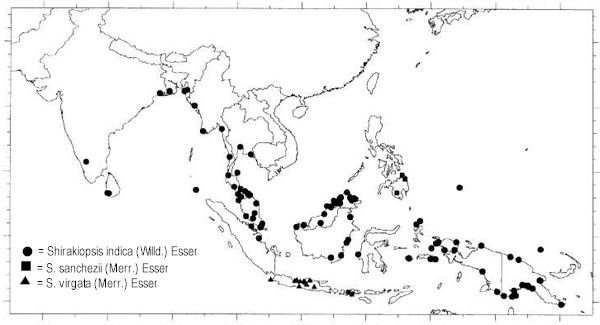
Distribution — Widely distributed from Sri Lanka and India (Malabar coast, Ganges) to Thailand, the Caroline Islands and the Solomon Islands; in Malesia known from the Malay Peninsula (incl. Singapore), E Sumatra, Borneo, Celebes, Moluccas, and New Guinea including the Bismarck Archipelago.
Habitat & Ecology — Found along rivers and seashores, in gallery, tidal and mangrove forests, in primary and advanced secondary forests of swampy and seasonally inundated places. Soil: clay, sand, mud. Very common to scattered. Altitude sea level up to 75 m. Flowering in Malesia: December to January, June to July, outside Malesia, however, the whole year through; fruits collected the whole year through. The seeds germinate only after 318–413 days (Ng, 1991).
Uses — The timber is used for canoes and is supposed as suitable for indoor work. Leaves have been applied to cure fever and gonorrhoea (Burkill, 1935). Fruits and leaves are boiled together with clothes as black dye, but also yellow-green colours can be obtained from it (e.g., in lower Thailand: Burkill, 1935). The green fruits are used as a fish poison, e.g., by the Dusun (Borneo). The "juice of the fruits" is applied by Kinomeri to cure toothache [NGF (Floyd) 8039]. The seeds contain a drying oil (Burkill, 1935) and can be eaten, whereas the fruit wall as well as other parts of the plant contains toxic latex, also known as fish poison (Dragendorff, 1898). In view of the variety of uses, the species is considered as an interesting crop species for places too wet for other crops (Purwaningsih, 1991).
Vernacular names — Thailand: Kula. Malay Peninsula: Gurah. Borneo: Apid apid, gurah (Bisaya and Malay), keboean. New Guinea: Irian Jaya: Fa (Asmat), farid, sakottoebo; Papua New Guinea: Dordi (Kinomeri).
Notes — 1. Hamilton (1837) explained that Roxburgh, to whom he sent his collection, transmitted it to Willdenow under the name Sapium bingirium. It may be, therefore, that the collections Roxburgh s.n. (G, BM, BR) and Wallich Cat. 7963 A = Herb. Roxburgh s.n. (K, K-WALL, P), both labelled as Sapium bingirium, are in fact isotypes of S. indica, and Sapium bingiricum of Baillon (1858) a homotypic synonym.
2. Merrill (1917) certainly was right that Ichthyoctonos litorea Rumph. must be referred to S. indica, not to S. virgata as had been done by earlier authors.
Shirakiopsis sanchezii (Merr.) Esser, Blumea 44 (1999) 189, Fig. 5 a–c, g–h; Map 5. — Sapium sanchezii Merr., Philipp. J. Sc., Bot. 7 (1913) 406; Pax & K.Hoffm. in Engl., Pflanzenr. IV.147.vii (1914) 423; Merr., Enum. Philipp. Flow. Pl. 2 (1923) 461; Salvosa, Lex. Philipp. Trees (1963) 123; Airy Shaw, Alph. Enum. Euph. Philipp. Is. (1983) 44. — Shirakia sanchezii (Merr.) Kruijt, Biblioth. Bot. 146 (1996) 93. — Lectotype (designated by Esser, 1999): Bolster 373 (UC), Philippines, Mindanao, Prov. Surigao, Surigao.
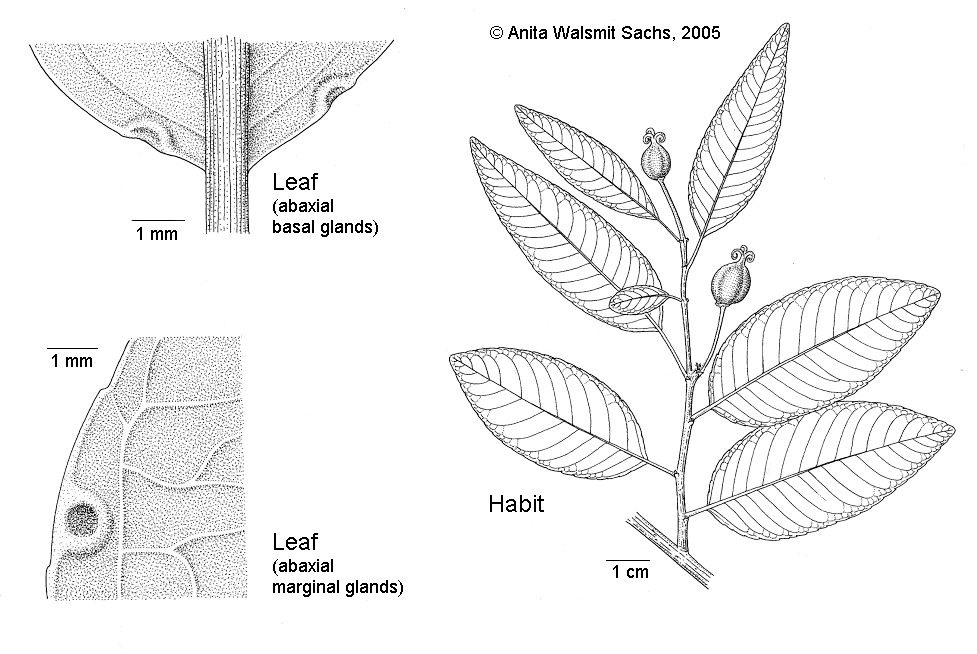
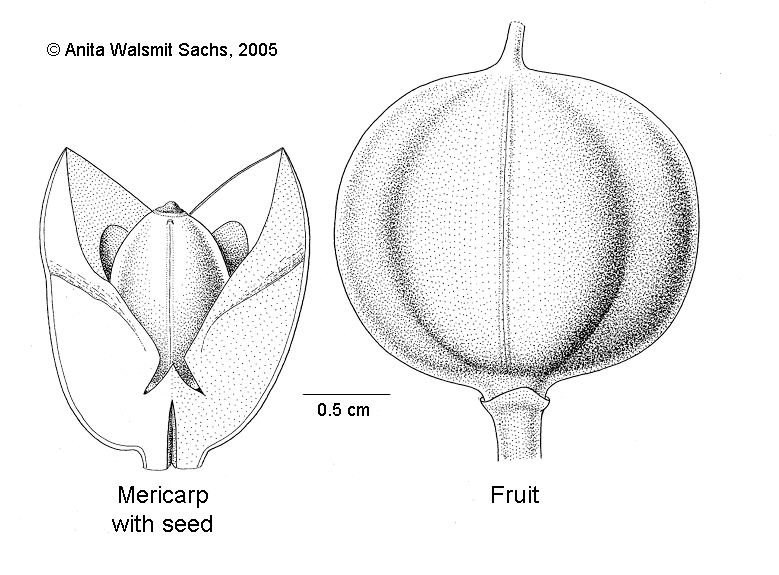
Tree, up to 15 m high. Young twigs pilose. Indumentum pale to yellowish. Bark c. 4 mm thick, somewhat rough, deeply fissured; inner bark brown, paler inside. Stipules 1.5–2 by 1.5–2 mm, entire to ciliate. Leaves: petiole 0.6–1.3 cm long, sparsely pilose to glabrous; blade ovate to elliptic, 5–10 by 2–3.5 cm, base obtuse, often slightly attenuate, apex acute to acuminate, upper surface pilose on midrib, lower surface almost glabrous and with 0–3 glands per side, 0.3–0.4 mm in diam., basal glands 0.5–0.7 mm in diam. and c. 1–2 mm above base of blade, secondary veins 17–25 pairs, angle with midrib 60–75°, smaller veins distinct. Inflorescences only studied in bud, these c. 20 by 4 mm, axis pilose. Bracts of staminate cymules c. 0.75 by 0.5 mm, pilose, further details not visible in bud. Staminate flowers sparsely pilose; pedicel c. 1 mm long in bud; calyx 0.6–0.7 mm long in bud. Pistillate flowers not studied, but according to fruits: distinctly pedicellate; calyx 1–1.5 mm long. Fruits: pedicel 15–30 mm long; schizocarp nearly circular in outline, 15–19 by 17–20 mm, deeply sulcate, fleshy only when young, dry when mature; style c. 2.5 mm long, stigma 3–6 mm long; mericarps separating easily, glabrous; pericarp 2.5–3 mm thick; remaining columella 7–8 mm long. Seeds c. 8 by 5.5–6 mm, rounded on the back, brown, caruncle absent to very inconspicuous.
Distribution — Endemic to Malesia: Philippines (Mindanao), Lesser Sunda Islands (Sumbawa).
Habitat & Ecology — In thickets and forests along or near the seashore, in monsoon forest on ridges. Flowering and fruiting: May, June.
Vernacular names — Lesser Sunda Islands, Sumbawa: Kayu tanduk; Philippines: Bantiáno (See, Merrill, Enum. Philipp. Flow. Pl. 2, 1923: 461; Salvosa, Lex. Philipp. Trees, (1963: 123).
Note — The collections studied from Sumbawa differ from the Philippine plants only in their fruits, being 18–19 mm long (instead of 15–17 mm). Obviously, no taxonomic separation can be corroborated.
Shirakiopsis virgata (Zoll. & Moritzi ex Miq.) Esser, Blumea 44 (1999) 189, Fig. 5 d–f; Map 5. — Excoecaria virgata Zoll. & Moritzi ex Miq., Fl. Ind. Bat. 1, 2 (1859) 416; Müll.Arg., Linnaea 32 (1863) 123; in DC., Prodr. 15, 2 (1866) 1216; J.J.Sm. in Koord. & Valeton, Bijdr. Boomsoort. Java 12 (1910) 613; Koord., Exkurs.-Fl. Java 2 (1912) 506; Backer & Bakh.f., Fl. Java 1 (1964) 499; Airy Shaw, Kew Bull. Add. Ser. 4 (1975) 114. — Sapium virgatum (Zoll. & Moritzi ex Miq.) Hook.f., Fl. Brit. India 5 (1888) 471; Boerl., Handl. Fl. Ned. Ind. 3, 1 (1900) 295; Pax & K.Hoffm. in Engl., Pflanzenr. IV.147.v (1912) 249. — Shirakia virgata (Zoll. & Moritzi ex Miq.) Kruijt, Biblioth. Bot. 146 (1996) 93. —- Type: Zollinger 3035 (holo U; iso A, BM, G, K, L, P; G-DC, n.v., IDC microfiche 2620/1), Java, Bantam.
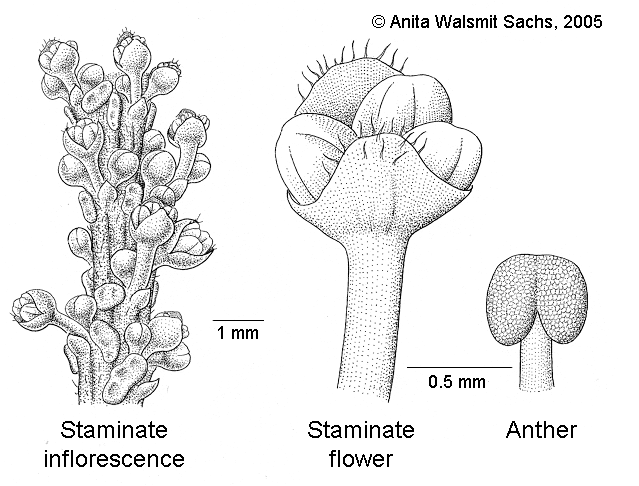
Tree up to 40 m high, d.b.h. up to 60 cm, branching 5 m above base. Not deciduous. Young twigs pilose, especially in the axils. Indumentum yellowish to pale. Bark brown, vertically fissured; inner bark pale yellow. Stipules c. 2 by 1–1.5 mm, ciliate. Leaves: petiole 0.8–2 cm long, pilose to glabrous; blade oblong to elliptic, (5–)7–13 by 2.5–4 cm, base obtuse, often slightly attenuate, apex acuminate, upper surface nearly glabrous, lower surface sparsely pilose to glabrous and with 2–10 glands per side, 0.25–0.4 mm in diam., basal glands 0.4–0.7 mm in diam., secondary veins (15–)19–26 pairs, angle with midrib 60–65°, basal pair with smaller angle, therefore parallel to leaf margin, intersecondaries distinct, smaller veins distinct. Inflorescences 40–70 by 5.5–6 mm, axis pilose. Bracts of staminate cymules 1.25–1.5 mm long, entire, pilose on whole surface or only on margin (ciliate), their glands 1.25–1.75 by 0.6–0.7 mm. Staminate flowers sparsely pilose; pedicel up to 1.5 mm long; calyx 0.5–0.7 mm long, ciliate; stamens with filaments 0.3–0.5 mm long when flowering, nearly absent in bud, anthers 0.25–0.4 mm long. Pistillate flowers 1(–2) per thyrse or absent; pedicel 4 mm long; calyx c. 1.5–1.75 mm long, entire; style not studied. Fruits: pedicel 8–15 mm long; schizocarp elliptic in outline, 23–31 by 16–18 mm when dry, acute at both ends, slightly sulcate, with leathery-fleshy outer layer, green but becoming blackish and wrinkled; style 4 mm long; hardly and tardily dehiscent; mericarp with fleshy outer layer 2–4 mm thick when dry, woody part of pericarp 18–21 mm long, wall 2.0–2.25 mm thick. Seeds 9–10 by 5–5.5 mm, pale brown to cream, without caruncle.
Distribution — Endemic to Malesia: Java.
Habitat & Ecology — Grows in primary and disturbed coastal forests on alluvial plains, periodically inundated. Soil: loam. Altitude: sea level up to 550 m. Flowering: July, but according to Backer & Bakhuizen van den Brink f. (1964) flowering the whole year through; fruiting: April, July to September.
Uses — The wood is durable and can be used for tools and houses (McDonald & Afriastini 3421). The uses listed by Dragendorff (1898) for India probably refer to S. indica and are erroneous.
Vernacular name — Java: Kisereh; see also Smith (1910) and Pax & Hoffmann (1912).
Notes — 1. Smith (1910) and Airy Shaw (1975) regarded S. virgata to be only a variety of S. indica, although they never formally transferred it. However, the fruits of the two taxa are sufficiently distinct to recognize them as distinct species.
2. The first citation of the species by Baillon (1858, as Excoecaria virgata Zoll.) was not accompanied by any additional information and does not constitute a valid publication.
3. Müller Argoviensis (1866) cited S. virgata from Moulmein, Burma, which probably was erroneous (Hooker, 1888). The species has never been collected outside Java, and the specimen seen by Müller Argoviensis (G-DC, IDC microfiche 2620/3) is a flowering one. Because the fruits are typical for this species, the mentioned specimen cannot be identified as S. virgata.
